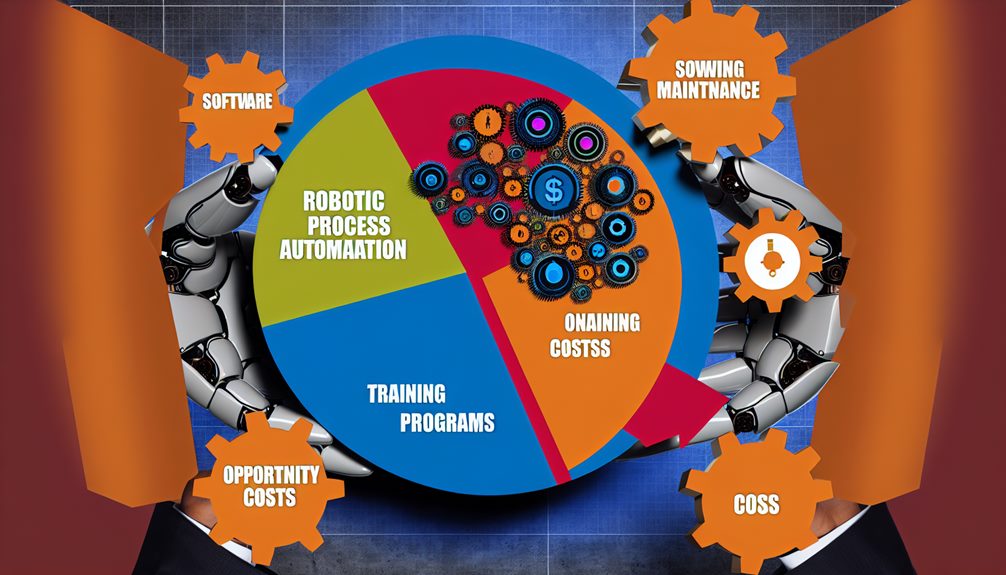
Understanding the total cost of ownership (TCO) of robotic process automation (RPA) solutions involves evaluating initial and ongoing expenses throughout their lifecycle. These costs include direct expenses like software licensing, hardware requirements, and implementation fees, as well as indirect costs such as maintenance, support, and necessary training for personnel. Additionally, organizations must consider hidden costs, including resistance to change and integration challenges with legacy systems. A thorough TCO assessment facilitates informed decision-making and accurate forecasting of future expenses, ensuring financial sustainability and scalability for the business. Further insights into this analysis can enhance your strategic planning for RPA investments.
Key Takeaways
- Total Cost of Ownership (TCO) for RPA includes initial investment, ongoing maintenance, support, training, and hidden costs that affect long-term financial sustainability.
- Initial investments encompass software acquisition, hardware costs, and human resource training essential for maximizing return on investment (ROI).
- Licensing and subscription fees significantly influence TCO, varying based on features and user count, requiring careful analysis for cost-effectiveness.
- Implementation and integration costs often surpass initial licensing fees, necessitating effective vendor selection and stakeholder engagement for successful deployment.
- Ongoing maintenance, support expenses, and training are critical to ensure operational effectiveness and adaptability in evolving business landscapes.
Defining Total Cost of Ownership
Total Cost of Ownership (TCO) is a detailed financial estimate that evaluates the direct and indirect costs associated with the acquisition and operation of an asset over its entire lifecycle. In the context of Robotic Process Automation (RPA) solutions, TCO encompasses not only the initial purchase price but also ongoing expenses related to maintenance, support, training, and potential scalability. Conducting a TCO comparison allows organizations to assess the long-term financial implications of adopting RPA technology versus traditional automation methods or competing solutions.
A detailed cost analysis is paramount for organizations seeking to leverage RPA effectively. This analysis must include both tangible costs, such as software licensing fees and infrastructure investments, and intangible costs, such as the impact on workforce dynamics and changes to existing processes. By taking a holistic approach to TCO, decision-makers can identify hidden costs that may not be immediately apparent, such as productivity losses during the changeover phase or expenses incurred from inadequate training.
Moreover, understanding TCO facilitates informed decision-making by enabling organizations to forecast future expenses accurately. This foresight is critical for businesses that prioritize financial freedom and sustainability in technology investments. Ultimately, a thorough TCO analysis serves as a strategic tool, empowering organizations to compare various RPA solutions and choose the one that aligns best with their operational goals and financial objectives. By prioritizing TCO, stakeholders can guarantee that their investments yield maximum returns while minimizing unforeseen costs.
Initial Investment Breakdown
The initial investment for implementing Robotic Process Automation (RPA) solutions involves several essential components that organizations must meticulously evaluate. These components typically encompass software acquisition, hardware requirements, and the costs associated with project planning and execution. Conducting a thorough cost benefit analysis is necessary to understand the financial implications of these investments and to guarantee alignment with the organization's overall investment strategy.
First, organizations must consider the software costs, which may include one-time licenses or ongoing subscription fees. Additionally, the necessary hardware infrastructure—such as servers, network capabilities, and security measures—plays a significant role in the successful deployment of RPA solutions. The initial capital outlay for these elements can be substantial, and consequently, careful planning is paramount.
Moreover, organizations should account for the costs related to human resources, including the training and skill development required for staff to effectively manage and operate RPA systems. This factor often goes underappreciated, yet it is crucial for maximizing the return on investment (ROI) from RPA initiatives.
Lastly, it is imperative that organizations adopt an investment strategy that not only evaluates immediate costs but also anticipates future scalability and maintenance expenses. This foresight will guarantee that the initial investment is not merely a sunk cost, but rather a strategic foundation for long-term operational efficiency and process optimization. By understanding the initial investment breakdown, organizations can make informed decisions that facilitate the successful integration of RPA technologies.
Licensing and Subscription Fees
When evaluating the total cost of ownership for Robotic Process Automation (RPA) solutions, licensing and subscription fees emerge as critical financial considerations. These fees can considerably impact the overall investment, necessitating a thorough understanding of vendor pricing models and the associated implications for budgeting and strategic planning.
Organizations typically encounter various licensing agreements, each with its own set of terms, conditions, and costs. Subscription tiers can vary widely based on the features offered, the scale of deployment, and the number of users. Consequently, careful cost forecasting is essential to avoid unexpected financial burdens.
Key considerations include:
- Vendor Pricing Models: Understanding the different pricing structures available, such as per-bot or usage-based fees.
- Subscription Tiers: Evaluating which tier aligns best with business needs and growth plans.
- Usage Metrics: Analyzing how usage patterns may affect overall costs and potential savings.
- Renewal Strategies: Planning for contract renewals and potential changes in pricing or service offerings.
- Competitive Analysis: Reviewing alternatives to guarantee the chosen solution remains cost-effective over time.
Implementation and Integration Costs
Implementing and integrating RPA solutions can represent a considerable portion of the total cost of ownership, often surpassing initial licensing fees. The intricacies of process automation demand meticulous planning and execution, which can lead to substantial expenses. Effective vendor selection is essential; organizations must consider not only the software's capabilities but also the vendor's experience with integration and support for specific business processes.
A thorough risk assessment is critical during the implementation phase. Identifying potential challenges—such as compatibility issues with existing systems or resistance to change—can mitigate costly delays. Change readiness within the organization plays a considerable role in guaranteeing successful user adoption, as employees must be equipped and willing to embrace new technologies.
Stakeholder engagement is another important factor, as aligning various interests enhances project scalability and fosters a collaborative environment. Resource allocation becomes a strategic consideration; organizations must guarantee that adequate personnel and time are dedicated to training and integration efforts.
Moreover, ongoing performance monitoring post-implementation is fundamental to evaluate the effectiveness of RPA solutions in achieving business objectives. Monitoring metrics should be aligned with organizational goals to facilitate continuous improvement and guarantee that process automation efforts are yielding the desired outcomes. Ultimately, a well-structured implementation and integration strategy, grounded in business alignment and user readiness, can greatly influence the overall success of RPA initiatives while controlling costs effectively.
Maintenance and Support Expenses
Maintenance and support expenses are critical components in the total cost of ownership for RPA solutions, encompassing ongoing maintenance costs, technical support requirements, and training and onboarding expenses. Organizations must anticipate these costs to guarantee the smooth operation and scalability of RPA systems over time. A thorough analysis of these expenses will facilitate informed budgeting and resource allocation, ultimately impacting the long-term viability of RPA initiatives.
Ongoing Maintenance Costs
Regularly evaluating ongoing maintenance costs is vital for organizations that have integrated Robotic Process Automation (RPA) solutions into their operations. These costs can greatly impact the total cost of ownership and necessitate careful consideration of various factors. Performance monitoring plays an essential role in identifying inefficiencies and making certain that the automation metrics align with business objectives. Additionally, regular software upgrades are necessary to meet compliance requirements and enhance functionality.
Organizations must also actively solicit user feedback to facilitate process optimization and address scalability concerns. This is particularly important as RPA solutions evolve, requiring change readiness to accommodate new technologies.
Key considerations in ongoing maintenance costs include:
- Vendor reliability: Evaluating the dependability of RPA vendors can mitigate risks associated with system downtimes.
- Risk evaluation: Understanding potential risks can help organizations prepare for future challenges.
- Automation metrics: Regularly reviewing performance metrics aids in validating the ROI of RPA initiatives.
- Process optimization: Continuous improvement should be a priority to maximize efficiency.
- Change readiness: Organizations must remain agile to adapt to evolving business landscapes.
Incorporating these elements will help guarantee the long-term success of RPA implementations.
Technical Support Requirements
The effectiveness of RPA solutions is greatly influenced by the technical support requirements that accompany their deployment and ongoing operation. These requirements encompass important aspects such as support scalability, which guarantees that the technical support can adapt to the growing demands of the organization. Effective troubleshooting processes are fundamental for minimizing downtime and maintaining operational efficiency, necessitating robust incident management frameworks that prioritize quick resolution.
User feedback plays a central role in refining support documentation and enhancing the overall user experience. Clear service level agreements (SLAs) are essential in establishing expectations regarding response times and resolution timelines, thereby fostering strong vendor relationships. Furthermore, performance monitoring is critical for identifying potential issues before they escalate, allowing teams to leverage upgrade paths effectively to maintain best system performance.
In addition, the interplay between support documentation and user training can greatly impact the success of RPA initiatives. Organizations must guarantee that their teams are equipped with the necessary resources to address challenges independently, promoting a culture of continuous improvement and innovation within the RPA ecosystem. These technical support requirements ultimately shape the total cost of ownership and the long-term viability of RPA solutions.
Training and Onboarding Expenses
Investing in extensive training and onboarding programs is crucial for maximizing the effectiveness of RPA solutions and minimizing long-term operational costs. Effective onboarding strategies and tailored training methodologies are essential to guarantee that employees are equipped with the necessary skills to utilize RPA technologies efficiently. This creates a foundation for user engagement and drives productivity.
Key components of successful training and onboarding include:
- Role-Specific Training: Customizing programs to meet the needs of different job functions enhances relevance and accelerates the learning curve.
- Skill Assessment: Regular evaluations help identify knowledge gaps and tailor training to individual employee needs.
- Knowledge Retention: Implementing techniques that reinforce learning guarantees that skills remain sharp and applicable over time.
- Continuous Learning: Encouraging an environment of ongoing education keeps staff updated on evolving RPA technologies and best practices.
- Employee Feedback: Actively seeking input from participants allows for the refinement of training methodologies based on real-world experiences and performance metrics.
Training and Change Management
Effective training and change management are critical components in realizing the full value of Robotic Process Automation (RPA) solutions. The successful implementation of RPA hinges on robust user engagement strategies that proactively address user resistance factors. These resistance factors may stem from fear of job displacement, lack of understanding of the technology, or insufficient support from leadership. To mitigate these concerns, organizations must adopt extensive training methodologies that cater to diverse learning preferences and promote a culture of continuous improvement.
Change adoption techniques play an essential role in ensuring that employees are not only trained but also motivated to embrace RPA solutions. This can be achieved through tailored programs that incorporate practical applications of RPA in daily tasks, thereby enhancing knowledge transfer processes. Furthermore, implementing effective employee feedback mechanisms allows organizations to gauge the effectiveness of training initiatives and make necessary adjustments based on real-world experiences.
Conducting organizational readiness assessments before deployment is essential to identify potential challenges and align resources accordingly. This proactive approach enables organizations to develop targeted strategies that facilitate smoother transformations. By prioritizing training and change management, businesses can empower employees to leverage RPA technologies effectively, fostering a more agile workforce.
Ultimately, the investment in extensive training and strategic change management not only enhances user adoption but also maximizes the return on investment in RPA solutions, paving the way for sustainable operational efficiency and innovation.
Hidden Costs of RPA
Understanding the total cost of ownership (TCO) of Robotic Process Automation (RPA) solutions requires a detailed evaluation that extends beyond initial implementation expenses. While organizations often focus on the upfront costs, the hidden costs associated with RPA can greatly impact the overall investment. These hidden pitfalls can lead to unforeseen expenses that erode the anticipated benefits of automation.
The complexity of processes targeted for automation can introduce various challenges. Factors such as integration hurdles with existing systems and scalability challenges may require additional resources, time, and expertise. In addition, organizations may face compliance risks, especially if the automated processes involve sensitive data. Therefore, guaranteeing robust data security becomes paramount.
Resistance to change from employees can additionally escalate costs. When employee morale is adversely affected, productivity may decline, counteracting the advantages of RPA. Additionally, organizations often encounter vendor lock-in, which can impose limitations on flexibility and adaptability, leading to increased long-term costs.
Consider the following hidden costs of RPA:
- Change resistance leading to decreased productivity
- Integration hurdles with legacy systems
- Compliance risks associated with data management
- Scalability challenges hindering future growth
- Vendor lock-in limiting strategic flexibility
A thorough understanding of these hidden costs is critical for organizations considering RPA solutions, as it shapes informed decision-making and helps in devising strategies that guarantee a successful automation journey.
Measuring ROI and Savings
Measuring the return on investment (ROI) for RPA solutions requires an all-encompassing framework that defines total cost metrics, encompassing both direct and indirect expenses. Analyzing operational efficiency gains is critical to understanding the impact of automation on productivity and resource allocation. Additionally, evaluating the long-term financial implications of RPA implementation provides valuable insights into sustainable cost savings and overall business performance.
Defining Total Cost Metrics
The assessment of Total Cost Metrics in Robotic Process Automation (RPA) solutions is pivotal for organizations aiming to gauge their return on investment (ROI) and identify potential savings. Effective cost assessment encompasses various dimensions that inform strategic decision-making, ensuring that financial forecasting aligns with long-term objectives. A thorough value evaluation should consider both direct and indirect costs, consequently enhancing budget planning practices.
To achieve accurate investment analysis, organizations should implement the following components:
- Expense tracking: Monitor all costs associated with RPA implementation and maintenance.
- Resource allocation: Assess how resources are utilized effectively to minimize waste.
- Risk management: Identify potential risks that could impact the financial viability of RPA initiatives.
- Benefit realization: Measure tangible and intangible benefits resulting from RPA deployment to justify investments.
- Performance metrics: Establish KPIs that reflect the efficiency and effectiveness of RPA solutions.
Analyzing Operational Efficiency Gains
Evaluating operational efficiency gains through Robotic Process Automation (RPA) necessitates a systematic approach to measuring return on investment (ROI) and realized savings. Organizations must establish efficiency benchmarks to assess the impact of RPA on operational workflows. By employing performance metrics, businesses can quantify improvements in process optimization, highlighting areas where automation scalability has led to enhanced productivity analysis.
The workforce impact of RPA is significant; it allows existing employees to focus on higher-value tasks, thereby improving resource allocation. Continuous improvement should be a core objective, with organizations regularly reviewing the integration of RPA solutions to align technology with business goals. This alignment guarantees that automation supports strategic initiatives while driving efficiency.
To accurately measure ROI, businesses should analyze the cost savings generated through streamlined operations against the initial investment in RPA technology. By leveraging data from performance metrics and efficiency benchmarks, stakeholders can make informed decisions regarding further investments in automation. This analytical approach not only clarifies the tangible benefits of RPA but also fosters a culture of innovation and flexibility, essential for sustaining growth in an ever-evolving market.
Long-term Financial Implications
A thorough understanding of long-term financial implications is essential for organizations implementing Robotic Process Automation (RPA) solutions. Conducting a detailed cost benefit analysis allows businesses to evaluate the potential return on investment (ROI) and savings over an extended period. This analysis involves not only the initial investment but also ongoing operational costs, maintenance, and potential scalability.
To effectively measure the financial impact of RPA, organizations should consider the following:
- Initial Costs vs. Long-term Savings: Assess the upfront investment against projected savings over time.
- Scalability Factors: Analyze how RPA solutions can adapt to increasing volumes and complexities without proportionate cost increases.
- Operational Efficiencies: Quantify gains from reduced processing times and improved accuracy, translating these into financial terms.
- Budget Forecasting: Incorporate RPA into financial models to predict future expenditures and savings accurately.
- Risk Mitigation: Evaluate the financial implications of reduced human error and compliance risks, which can lead to significant cost avoidance.
Long-Term Financial Impact
Long-term financial impact of Robotic Process Automation (RPA) solutions extends far beyond initial implementation costs, necessitating a thorough analysis to fully understand their value proposition. A detailed cost benefit analysis (CBA) reveals that while upfront expenditures may be substantial, the potential for significant operational savings can yield a favorable return on investment over time. These savings primarily arise from enhanced efficiency, reduced error rates, and the ability to reallocate human resources to more strategic tasks.
In considering budget forecasting, organizations must account for both direct and indirect costs associated with RPA solutions. Direct costs include software licensing, maintenance, and infrastructure, while indirect costs might encompass employee training and potential downtime during the conversion phase. Over an extended period, these factors should be meticulously evaluated to ascertain their impact on overall financial performance.
Furthermore, the scalability of RPA solutions can lead to compounded benefits. As processes are automated, organizations can adapt to increased workloads without proportional increases in headcount or operational expenditures. This scalability not only facilitates budget forecasting but also enhances financial agility, allowing businesses to respond swiftly to market changes.
Ultimately, the long-term financial impact of RPA encompasses not only quantifiable savings but also strategic advantages that foster growth and innovation. By leveraging RPA, organizations can create a more resilient financial framework, paving the way for sustainable competitive advantage in an increasingly dynamic landscape.
Frequently Asked Questions
How Does RPA Impact Employee Morale and Productivity?
RPA can enhance employee engagement by improving process efficiency; however, it may also induce automation anxiety. Ultimately, the balance between job satisfaction and perceived job security influences overall productivity and workplace morale considerably.
What Industries Benefit Most From RPA Implementation?
Industries such as healthcare, finance, manufacturing, retail, insurance, and legal sectors greatly benefit from RPA, achieving healthcare efficiencies, financial accuracy, supply chain optimization, customer service enhancement, manufacturing productivity, retail automation, and ensuring legal compliance.
Can RPA Be Scaled Easily Across Different Departments?
RPA can be scaled across departments, yet scalability challenges arise due to varying processes and systems. Effective cross-departmental integration requires a nuanced approach, ensuring alignment with organizational goals and facilitating seamless automation across functions.
What Are the Common Pitfalls in RPA Adoption?
In the intricate dance of RPA adoption, implementation challenges and change management often emerge as stumbling blocks. Organizations must navigate resistance to change, inadequate training, and misalignment of objectives to harness the true potential of automation.
How Does RPA Compare to Traditional Automation Solutions?
RPA offers distinct advantages over traditional automation solutions, including enhanced flexibility and scalability. However, organizations must navigate RPA challenges such as integration complexities and workforce adaptation, necessitating a thorough evaluation of both methodologies for ideal implementation.